I’m standing close to the
edge of a deep gorge, gazing out at the plunging drop framed by the misty blue
haze of mountaintops when there’s a movement in the grass behind me.
I almost jump out of my skin
and move hastily back from the ledge. I turn just in time to avoid stepping on
the toes of a massive, golden lion-maned baboon who’s crept up to investigate a
particularly tasty-looking clump of grass. We blink at each other in surprise,
and then both scurry warily away.
He lopes off to the safety
of a cluster of nearby trees; I step smartly in the opposite direction. But
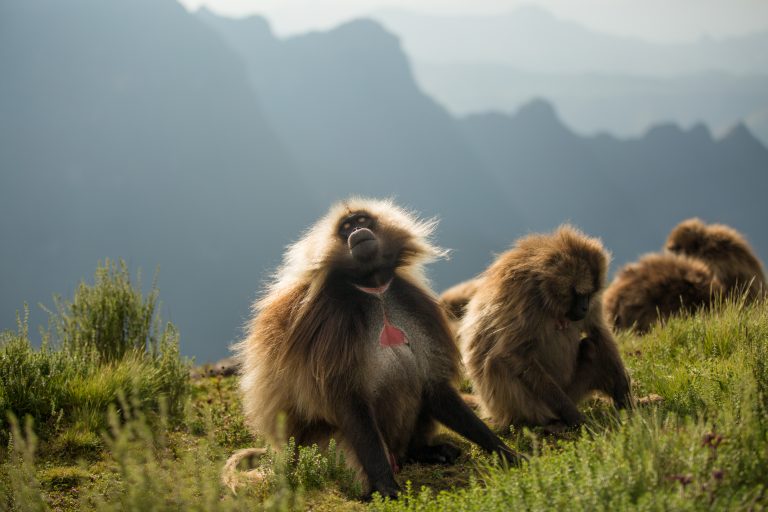
just 10 metres on, I stop. Here there’s a mob of around 30 Gelada baboons, some
with tiny babies clinging to their fronts and bigger ones balancing on their
backs, running
around looking almost like a baboon-jockey version of the Melbourne Cup. Others
gambol, play with each other, dig for roots and pick off seeds, and teach their
young exactly how to do all of those things.
In one of the world’s most renowned
trekking spots – Ethiopia’s stunning UNESCO World Heritage-listed Simien Mountains
National Park – you’re very rarely alone. If it’s not the Gelada baboons, it’s
myriad other creatures.
There’s the walia ibex, a
kind of goat-like creature with magnificent arching horns, the black and white
colobus monkeys, jackals, hydrax and, if you’re very lucky (I wasn’t), the
Ethiopian wolf, one of Africa’s most endangered carnivores and Africa’s rarest
canid.
This is an area that’s
charmed visitors throughout the years. In the 1920s, intrepid British travel
writer Rosita Forbes described it as having “gorges of clouded amethyst” while
UNESCO lauded it as “one of the world’s most spectacular landscapes”, with its
jagged mountain peaks, deep ravines and precipices plunging over 1,500 metres.
As you stride through
grassy meadows scattered with Everlasting Daisies, bright yellow St John’s Wort
and golden acacia, it’s easy to understand its charm. And as you scramble up basalt
cliffs and admire the breathtaking views in every direction – always looking
out for the tragic giant Lobelia, a lofty plant that grows for up to 20 years,
flowers once, then dies – the sky’s rarely empty either.
The park is revered by
birders for its variety and sheer numbers, with awe-inspiring glimpses of the
huge lammergeiers,
the Bearded
vultures, with their two-metre wingspan, and Tawny eagles.
I find it enormous fun to
trek in a place that’s both stunningly beautiful and teeming with wildlife. So
often I’ve trudged along mountain passes, down ravines and across vast plains,
feeling ineffably lonely. Scenic magnificence is all very well, but when you’re
the only living being on the horizon, it can also be just a little oppressive.
Enjoying it in the company
of so many creatures adds another dimension to the whole experience. “And
they’re all animals that are more scared of humans than you are of them,” says
local guide Shiferaw Asrat. “That’s always reassuring.
“As Ethiopia becomes more
and more of an emerging tourism destination, we’re seeing so many more people finding
out about this national park and inquiring about coming here.”
Those numbers have been
boosted by the opening up of new hiking trails, the program of enticing locals
with offers of new free housing out of the ranges and down into villages
outside the protected areas, and also a brand new luxury eco-lodge to stay in.
Asrat played a huge role
in that. Together with fellow guide Meles Yemata, he saw the need for
accommodation in the mountains and gathered 150 workers from a local village to
build the Limalimo Lodge on a 2900-metre-high ledge from local stone hauled up
the slopes, rammed earth, eucalyptus wood for ceilings and vast expanses of glass. Then, when they’d
finished, he employed 38 of those to work there, and launched in early 2017.
“The staff are now the
heart and soul of this place,” Asrat says, sitting in the vast communal space
at the centre of the complex, away from the large individual villas now hidden
away amongst the trees on the mountain slopes. “People love coming here as it
feels so secluded.”
After a hard day’s
trekking, it’s certainly a fabulous place to unwind, especially with a drink in
hand watching the sunset casting a scarlet glow over the mountain peaks … and
the trails you’ve just conquered.
SIX OF THE WORLD’S OTHER GREAT TREKS
Nepal – The Annapurna Circuit (up to 20 days) with great Himalayan scenery, lots of teahouses to stay in and altitudes from 760 metres to 5420 metres. nepaltrekkinginfo.com
Patagonia – The W Route in Torres del Paine national park in Chile (4-6 days), through spectacular mountains and around glaciers, waterfalls and lakes, with the highest point at 1240 metres. torresdelpaine.com/en
New Zealand – Milford Track (four days) on the South Island, viewing the country’s tallest waterfall, gorgeous glaciers and sculpted valleys, and staying in valleys along the way. milfordtrack.net
Tasmania – Overland Track (six days) through the Cradle Mountain-Lake St Clair National Park, by Tasmania’s highest mountain Mt Ossa, glassy lakes and breathtaking views. parks.tas.gov.au
Scotland – West Highland Way (7-8 days), in the Scottish Highlands, going from Glasgow to the beauty of Loch Lomond, through the moors to the foot of Ben Nevis. westhighlandway.org
Italy – Cinque Terre (2-4 days) is a busy route these days, but with good reason: that trek between the five fishing villages high on the cliffside with dizzying views of the coastline is one of the world’s most magical journeys. parconazionale5terre.it/
There are a number of airlines, including Emirates and Ethiopian
Airlines who fly into Addis Ababa. Ethiopian Airlines also fly from Addis Ababa
to Gondar, the nearest airport to the park. ethiopianairlines.com
STAY
Limalimo Lodge (limalimolodge.com) costs from US$150
per person per night, including meals and some drinks.
TOUR
Peregrine offers a range of tours around the country, including a trek
through the Simien National Park, on the ten-day Highlights of Ethiopia,
costing from $4,830 per person twin-share. peregrineadventures.com
Sue Williams was a guest of Peregrine
This review first appeared in the Sydney Morning Herald/Sun Herald Traveller section
4.5 / 5 stars THE LOCATION When the letter comes that you’re being awarded a knighthood, this is the hotel to stay. Only a hop, skip and a jump from Buckingham Palace, you’ll be able to have tea with the Queen and still get back in time for afternoon champagne. On a quiet street in Belgravia just off Buckingham Palace Garden and Green Park on the other side, it’s also extremely handy for Harrods for that special outfit for the day, or Sloane Street or Chelsea if you’re looking for something a little quirkier. Getting in and out is a cinch too, via a five-minute cab drive from Victoria Station for the direct line to Gatwick Airport.
THE SPACE London’s first design-led boutique hotel when it was built 26 years ago, with a Georgian-styled façade of weathered bricks, Portland stone and arching windows, it blends in beautifully with its surroundings. Inside, it’s a different world, however, with contemporary styling by Italian architects Laboratorio Associati of Milan which became a benchmark for modern hotels around the world. It has 41 generously- sized rooms and suites, off curved corridors panelled in black corrugated wood. The lobby has a high atrium ceiling painted with a skyscape, with 24-hour concierge to reserve theatre tickets and order limousines, a bar to the side and a small gym in the building. Guests are free to use the spa in the sister hotel, the COMO Metropolitan, 10 minutes’ walk away.
THE ROOM The very first hotel from the international COMO Hotels and Resorts group, it smashed records from the start, with the unprecedented sum – for 1991 – of a million pounds spent on each individually designed and decorated room. The style is open plan, the décor is simple and elegant, the bathrooms are Italian marble (of course), there’s good desk space (a personal favourite), and my suite also had a private balcony with table and chairs. Everything, like temperature, lighting, doorbell, butler call and electronic ‘Do Not Disturb’ sign is operated from a touchscreen console.
THE FOOD
Ah! The food! The hotel has Basque restaurant Ametsa on site, the first venture overseas of the celebrated three-Michelin-starred Arzak in San Sebastian, Spain, which, within six months of its opening four years ago, received a Michelin star of its own. It’s an attention-grabbing space, with 7,000 glass tubes filled with colourful spices dangling from the ceiling, and an interesting menu of locally-sourced and organic produce from the owner, Elena Arzak, who was voted the World’s Best Female Chef in 2012. I tried a tasting menu, including seared scallops, a hemp cracker and parsley puree, and monkfish with tapioca caviar and a mango reduction, with all courses paired with Spanish wines. Delicious!
STEPPING OUT It’s a short walk to the fun boutiques of Sloane Street, the theatres of Piccadilly and the restaurants of Mayfair, and so easy for connections to both Gatwick and Heathrow. THE VERDICT Apparently 25 per cent of reservations for this hotel are from repeat guests, and you can understand why. The service is friendly – some of the concierge have been here since it opened – and discreet, the rooms are beautiful and the central London setting is incredibly convenient. HIGHLIGHT The food is pretty sublime, from the innovative dishes of Ametsa to the tapas you can have in the hotel bar, and the healthy breakfasts. LOWLIGHT It can be hard getting a late checkout. The hotel’s so popular – and comparatively small – it seems to be often booked out. ESSENTIALS COMO The Halkin, 5 Halkin Street, Belgravia, London SW1 Entry rate £475 per room a night. Phone +44 (0) 207 333 1000. See www.comohotels.com/thehalkin Rating: 4.5 out of 5 Sue Williams stayed courtesy of COMO Hotels and Resorts.
This review first appeared in the Sydney Morning Herald/Sun Herald Traveller section
Fifty years ago she was the Kiwi Bond Girl, playing opposite, George Lazenby, the only 007 ever to hail from Australia. Half a century later she’s one of the world’s architectural style icons, with passion and energy to burn.
Anouska Hempel … Bond girl to iconic interior designer
When the legendary – and now 76-year-old – Anouska Hempel arrived at 10pm after a 14-hour flight from her current home in London to inspect the fixtures and fittings of the new five-star boutique hotel she’d designed in Singapore, everyone expected her to sleep.
“And she didn’t at all,” says Marina Mathews, spokesperson at the Six Senses Duxton. “She was inspecting things and fixing everything until midnight. She only does the occasional project – her ‘passion’ projects – and when she’s working on them, it seems she has the energy of a 26 year old!”
This
project, the first city hotel from the Six Senses hospitality and wellness
company, certainly bears witness to that passion. The redesign of a row of eight
early-19th Century traditional shophouses into a slick modern hotel close
to the centre of Chinatown has become a stunning shrine to good taste, while
also winning a national architectural heritage award.
It’s the
latest hotel hit from the model and actor turned designer who went to school in
Sydney’s south before moving to England in the swinging 1960s with just 10
pounds to her name. The woman who went on to play opposite George Lazenby’s
Bond in On Her Majesty’s Secret Service,
later launched one of the world’s first luxury boutique hotels, Blake’s in
London in 1978, and now has a string of successful establishments behind her.
This new 49-room
heritage addition in Singapore is just as spectacular. Going through the front
doors, you enter a sleek Chinese-Malay-European world of black lacquer, gold
and yellow with Chinese screens, wallpaper made from reproduced old land contracts
from the 1700s, and calligraphy brushes of all shapes and sizes.
Screened off
to one side are the 50-seat Yellow Pot modern Chinese restaurant and the
striking 20-seat antiquarian-themed cocktail bar with its heritage
stained-glass ceiling, mustard, black and gold colour theme, and objets d’art
from Hempel’s own collection from around the world.
On first
sight, it took a few moments to realise I hadn’t actually drawn breath, so
taken aback was I by the vision of pure, unadulterated glamour.
But it’s not
only about the form. The giant Chinese script in gold by the entrance –
translating as Prosperity, Happiness and Health, and Longevity – reminds us
that this is a Six Senses hotel which prioritises its guests leaving healthier
than when they arrived.
That mission
starts from the beginning too, when you’re invited to take off your shoes and
step into a giant bronze Himalayan ‘singing bowl’ for a few moments of quiet mindfulness.
As you stand there, with your eyes closed, the bowl is struck with a gong and
the vibrations pulse through you, so you don’t actually even have the space of
think of anything else.
There’s a
normal-sized singing bowl in every room as well to allow you to continue the
practice.
Every guest
is also invited to a personal consultation with a physician of traditional
Chinese medicine. Happily, mine gave me the all-clear. Sadly, I fared less well
with the outdoor yoga class … but plenty of individual tuition to stop me
falling behind.
After
December 1, guests will also be able to use the spa, rooftop lap pool and gym
of the sister hotel, Six Senses Maxwell, that will open five minutes’ walk
away.
Back at the
Duxton, you find two chilled little glass bottles of complimentary tinctures in
the in-room minibar every day; one to be taken first thing in the morning to
detox and the other to be taken last thing at night to improve sleep and reduce
anxiety.
Finally,
there’s a little wellness bag placed in the room at turndown, with Tiger Balm,
digestive pills, an adult colouring card and pencils, nutmeg oil for muscle aches
and brainteaser puzzles for keeping the mind sharp. And no, I couldn’t do any
of those either.
The rooms are
also quirky sanctuaries of style, either all-black or all-white and with no two
exactly the same, depending on the historical layout of the original three-storey
buildings. Some are two-storey with the living area downstairs and the bedroom
upstairs, linked with a restored spiral staircase, others have four-poster beds
and a few even have skylights.
Yet it’s in
the cocktail bar where you perhaps get the greatest sense of Anouska Hempel
herself.
It’s hard to
go past the cocktail On Her Majesty’s Secret Service – a dry gin martini with
yuzu and green tea bitters. But for the more determinedly dashing, there are
also three variations of the Bond-approved classic martini, including a dirty
martini with house-made pickled green chilli and brine, and clouded rather than
shaken or stirred.
Trip notes
FLY
You can fly to Singapore with many
airlines, including Qantas, Singapore Airlines and Scoot.
STAY
Six Senses
Duxton is a beautiful new five-star boutique hotel close to Chinatown. See sixsenses.com/hotels/duxton/destination.
Rooms from SGD$390.
EAT
Yellow Pot at
the hotel serves both classic and innovative Chinese cuisine, with the accent
on healthy, organic ingredients, and is decorated with yellow pots of all
shapes and sizes.
Sue Williams was a guest of Six Senses Duxton
but travelled at her own expense.
If you love books and travel, there’s something doubly
enjoyable about reading a novel set in the very place that you’re visiting.
Author Mark Dapin once told me it was an ambition of his to
read all of Graham Greene’s novels in the places they were set. It was an idea
I was happy to steal.
This writer’s new crime novel Tunnel Vision (Affirm Press, $29.95) is set in and around present-day Saigon and was written very much with the travelling reader in mind.
Having now read Our
Man in Havana in Cuba, The Quiet
American in Saigon and The Power and
the Glory in Mexico (albeit not in the remote towns described therein) I
can see his point. A trip to Argentina (The
Honorary Consul) and Vienna (The
Third Man) are working their way up the to-do list, although Brighton and
its rock can wait.
Our Man in Havana
is such an authentic description of British spies’ tradecraft, that MI5 were
considering charging Greene under the Official Secrets Act, according to John
Le Carre in his memoir The Pigeon Tunnel.
With Cuba having been virtually trapped in amber, like an
exotic bug, since 1959, the novel makes a pretty good guidebook for travellers
too.
The same applies to The
Quiet American and Saigon, possibly more so. The clamour of Dong Khoi may
have increased since the street was called the Rue Catinat, but its essence
remains the same.
Some buildings have gone but others that feature in the
novel, as well as Philip Noyce’s superb 2001 movie, are still there,
functioning as the hotels, bars and cafes that were frequented by Greene and
his jaded hero Fowler.
And since few bombs fell on Saigon during the American war,
as it’s called there, most of the iconic buildings – such as the Opera House,
Notre Dame Cathedral and the Central Post Office – are intact too.
You can still venture into the post office where the rows of
elegant telephone booths, even those now converted to ATM cubicles, transport
you to a time when journalists like Greene and Fowler might be dictating
telegrams or frantically trying to get an outside line to their offices in the
UK.
I could never aspire to the literary heights achieved by
Greene but, as a frequent visitor to Vietnam, I too succumbed to the romantic
charms of Saigon when writing my new novel, Tunnel
Vision.
However, instead of the stylish bars of the Continental and
Rex hotels, I decided to take my
characters to an Airbnb or into the garish, sinful streets of Little
Tokyo.
As far as I can recall, neither Greene nor Fowler ate chilli
snapper with morning glory at the Ben Thanh night market, drank Triple-3 beer
in the Liberty Central nor had clandestine meetings with police contacts in the
Old Compass café. But I like to think
they might, if they were there today.
Saigon, aka Ho Chi Minh City, is much more of a tourist
destination now than it was back in the 1950s when the French were being edged
out and the Americans were starting to move in. And that was Green’s forte,
being in the right place at a time of great change – essential for both
journalists and spies alike (and he was both).
But I was happy to have my characters do the tourist thing
as the plots unfolded – explore the Cu Chi tunnels, help a kid who accosted
them in the park with her English homework, hang out in Highlands cafes and
head for the coast at Vung Tau.
Back in the day, Greene was more concerned with exploding
bicycles than cavalry charges of scooters, but you couldn’t set a novel in
present day Saigon without putting a character on the back of a bike.
That’s just being true to the location and the times, and if
travelling readers get a frisson of added enjoyment from reading the book in
situ, it will be a bonus.
The novel as guidebook has come into its own since the days
when every other habitue of a café listed in Lonely Planet would be thumbing
through a copy of the travellers’ bible.
That was before TripAdvisor emerged as an up-to-date but
middle-of-the-road online manual for the casual tourist.
However, Martin Cruz Smith’s novel Havana Bay is a more entertaining guide to modern Cuba than any
number of starry reviews, while Michael Connelly’s crime novels – especially
the Bosch series – contain innumerable handy hints on where to eat and drink in
Los Angeles.
Ian Rankin’s novels are as good a guide as you’ll get to
Edinburgh and there’s even a guided tour for those less interested in the
city’s many competing Harry Potter offerings.
Switching to romance from crime, there’s a whole industry
growing up around Eat, Pray, Love tours
of Italy, India or Bali … or all three.
Tours can help travellers on a tight schedule cut to the
chase, but there’s a lot to be said for just finding a bar, restaurant, café,
park or street mentioned in a novel, then going there, book in hand.
And you never know, the person sitting opposite you, tapping
away on their laptop, might be Facebooking or checking TripAdvisor … or they
could be writing the bestseller you’ll see in the airport bookshop, the next
time you travel overseas.
Breakout: BOOK TOURS
Millennium Tour,
Stockholm, Sweden
If you are a fan of Scandi-noir, you’ll know the recent upsurge
in interest began with the late Stieg Larsson’s novel The Girl with the Dragon Tattoo, its sequels and movies. A hosted
walk in the Swedish capital Stockholm will take you through Södermalm where computer
hacker supreme Lisbeth Salander and her journalist friend and protector Mikael
Blomkvist lived. Like most works of fiction, the places are real or have factual
equivalents. The two-hour tour in English takes place every Saturday at 11.30
am and cost $23. Book via stadsmuseet.stockholm.se.
Jane Austen, Bath,
England
The city of Bath in South-West England is known for its
graceful architecture but possibly less so for the fact that Jane Austen lived there
for five years in the early 1800s. The city was the setting for two of her
novels – NorthangerAbbey and Persuasion – and a guide in Regency costume from the Jane Austen
Centre leads walking tours of literary highlights every summer weekend. There’s
more at janeausten.co.uk
Harry Potter and
Inspector Rebus, Edinburgh, Scotland
There are so many Harry Potter/J. K Rowling tours wandering
the streets of Edinburgh that you could end up as part of one without even
realising it. All of them have a slightly different appeals and most will visit
one of the cafes that claim they kept Rowling caffeinated while she wrote. Google
“Harry Potter Tours” and check the online reviews to see which one suits you
best.
However if your tastes run to more grown-up and darker
matters, a walking tour in the footsteps of Inspector Rebus from Ian Rankin’s novels
leaves the Royal Oak pub every Saturday at noon, costing $27. Go to rebustours.com.
Harry Bosch, Los
Angeles, USA
A tour of Harry Bosch’s Los Angeles – now even better known
thanks to the TV series – takes in locations from the books and screen drama,
from the bars and diners he frequents to the places where bodies were found. Based
on author Michael Connelly’s own suggestions, this tour is $956 for six people. Online reviews are all five stars – that
would have to be a clue. Go to toursbylocals.com/HarryBosch-PrivateTour
Graham Greene,
Saigon, Vietnam
There are no obvious tours related to The Quiet American – partly because the city and country has so
much else to offer and because only Vietnamese nationals can be tour guides.
However, Saigon resident, historian and author Tim Doling
has posted an excellent article on his own website, that tells you where to go
and all you need to know. Go to historicvietnam.com/graham-greenes-saigon-revisited/.
This writer’s new crime novel Tunnel Vision (Affirm Press, $29.95) is set in and around present-day Saigon and was written very much with the travelling reader in mind.
I don’t know what it was that inspired me to embark on a four-day cycling adventure in Vietnam with my (grown-up) son.
We were meeting there to spend a week together anyway but four days of cycling from the coast at Hoi An to the mountain town of Da Lat – albeit with lots of support vehicle time – seemed a little ambitious both physically and emotionally.
A previously fractured, still occasionally fragile relationship might buckle under the strain of a week in each other’s company, even in more serene circumstances, let alone with the added edge of seeing who could get up the hills fastest (or at all).
But a day in Saigon, then two nights in Hanoi were enough to get us past the more painful echoes of the distant past. After that, it was more about shared fresh experience than ancient injuries.
It’s all about perspective, as I discovered on the second day when, after an hour of cycling, Jamie was suffering in the heat and humidity.
Up to that point, our small procession had been the guide, then me, then the son and heir, taking up the rear as he absorbed the over-abundance of sights, sounds and smells that assail you, travelling through central Vietnam at ground level.
As Jamie poured water over his head, I suggested he take the middle spot, thinking I could keep an eye on him in case he wilted (he has 18 years on me but I have that many fewer kilos of excess baggage).
When we stopped for lunch I asked him if he was OK now.
“Yes, fine,” he replied, then a thought struck him. “Is that why you went to the back?”
“Uh-huh,” I confirmed, feeling smugly paternal.
“Oh, I thought it was because you couldn’t keep up!” he said, blithely.
Perspective, see.
The cycling trip did not get off to the best of starts. We knew the area we were passing through may or may not have been hit by Typhoon Damrey but an email to the cycle tour company confirmed the trip was going ahead.
However, when we arrived at Da Nang airport for our transfer to Hoi An, where the tour was due to start the next day, the driver stopped a kilometre along the road when he got a phone call.
At the same time my phone beeped back to life and I got a text telling me not to come to Hoi An – it was under water. First the rains had hit, then the authorities had opened the upstream dam. The police weren’t even letting people into the town.
Again it’s about perspective. More than 70 people had died in the typhoon so we weren’t making a fuss. All we needed was to know where we were going to be staying that night and if we would be travelling as planned in the morning.
We were eventually delivered to the Luxtery hotel in Da Nang – “a mixture of luxury and mystery” – which was fine. It seemed to be mostly empty and for our solitary lunch in a massive dining room we were attended on by a waitress who hovered anxiously nearby then suddenly came over and said: “I have to go home now.”
Well, OK. That’s more than we needed to know, but on you go. Don’t forget your brolly.
That night we ventured across the road, grateful for the $40 North Face rain jackets we had bought in Hanoi the previous day. We landed up in a Korean barbecue restaurant – more of a shed, really – where the free starter was quail eggs and we had our own mini charcoal barbie on a chair beside our table.
The finale was a dish called something like Beef Lost In Stone and involved pouring beer over the lid of a hotpot which then rumbled, hissed and belched steam like an overactive geyser. It was delicious.
The next morning we met our tour guide Vien and driver Bun and, in an effort to get past the flooding, headed south down Highway One to Binh Son, where we stopped on a muddy corner and were introduced to our bikes for the first time.
They were pretty fancy 18-speed mountain bikes with shock absorbers in the front forks and what look like tractor tyres on the wheels. We were grateful for the off-road capabilities about five minutes later when our route across a causeway disappeared under a sheet of water.
Soon we were wading for the first but certainly not the last time. The rest of the day would see us turned away from flooded roads, forcing us to find less well-policed (and often more flooded) routes.
Our first stop brought us noodles and beer for lunch in an anonymous roadside café. Later, we had a sobering visit to Son My, site of the notorious My Lai massacre in 1968 when American troops went on a rampage killing up to 500 unarmed men, women and children.
That first night on the road was spent in a strange resort in Sa Huynh. This was real old school Vietnam – well, post ‘Open Door policy’– built you might imagine for senior party members and their families.
Semi-shuttered because of the typhoon, the dark timber villas and the sound of the crashing surf created a feeling of “Key Largo” and you half-expected Humphrey Bogart to appear and tell us we were stuck there for the duration.
Day two brought our first serious hills – two peaks of about 150 metres each – on which I learned three things. Switching off the squidgy shock absorbers makes going uphill a lot easier and switching them back on again means you can get downhill on a potholed road at high speed without breaking your wrists.
Also, the psychological effects of seeing a sign warning of a 10 degree slope are devastating when you are already running on diminishing self-belief. On the other hand, father-son competition will get you to that sign in the first place.
Lunch was Vietnamese pancakes, self-wrapped in squares of rice paper that looked suspiciously like old-fashioned toilet roll. But they were delicious and the lady in the roadside shed had to be asked to stop cooking for us.
We were still very much in the typhoon-hit region and the sight of small banana plantations, literally flattened by the storm, was heartbreaking. This was someone’s livelihood, in an area where there isn’t much margin for error when it comes to keeping body and soul together.
Night two was spent in the Seagull Hotel, Quy Nhon. We were glad of the pictures in the menu which was mostly in Vietnamese and Korean. I rarely eat in hotels when I’m travelling, but any food in Vietnam is better than your average hotel meal elsewhere.
Day three brought a lot more urban roads and streets and we started by skirting the former US Tuy Hoa airbase (now Dong Tac airport). Despite this being my eighth trip to Vietnam, I was seeing more of the people going about their daily lives that I’d ever experienced before.
Throughout the trip, kids took great delight in shouting “hallo!” as we passed, and giggling when we responded. Some teenagers gave us a rowdy reception as we waded across another flooded causeway in Hoa Hiep Nam, but it was all in good fun and, anyway, they backed off sharpish when they saw Jamie’s tatts.
Finding somewhere for lunch became a quest, as many of the truck stops on the highway were closed due to severe storm damage.
Our hotel on Nah Trang, the Rosaka, was a step up in class and Nah Trang is a noisy, lively, brightly lit tourist town and there were a lot of Chinese and Russian tourists around.
Our last day on the bikes saw us heading for the hills and the former French summer retreat of Da Lat. The support van did the heavy hill work of the first 100 metres of elevation and, thankfully, the final 1000. In between we had a 35km ride through a glorious valley and finished up with a 15km hilly dash through Da Lat to our hotel, the splendid Monet Garden.
There is nothing quite like cycling through a country where 95 percent of the population travels on two wheels. The food in roadside stalls was so delicious it was almost a cliché, the hotels were pretty good, the guide was encouraging when he needed to be but mindful of our limitations.
We only did 170 km over the four days but the sense of achievement from wading through floods and taking on apparently endless hills was worth the aching muscles. I would recommend this tour to anyone who can ride a bike, but you’d want to ensure all your party had around that same level of fitness and cycling ability.
And as for the father-son issues, I can only speak for myself but I think we built some bridges and smashed a few barriers and that made every pedal stroke doubly worth the effort.
This is an experiment. Can I keep a daily diary of my trip to Portugal to walk a 120 stretch of the Rota Vicentina? Can I do the bloody walk, let alone write about it. I set off from Sydney this week to meet my writer friend Kieran and tackle the longest walk I have ever undertaken in my life. Read on …
Day 1: Flying out of Sydney, premium economy on BA, you forget how bloody long that trip to London really is. Seats in Premium on the 737-300 are big enough but the tall guy next to me struggles a little, even with the generous leg room.
Note to self, book an aisle seat next time – you’re over the wing anyway so a window seat has nothing going for it apart from some minimal random space between your seat and the side wall.
Service is OK and the food is surprisingly palatable. But a nightclub queue style rope appears across the gangway blocking our access to the Business Class toilets.
And that is an issue. There are only two toilets for all of premium and economy on our side of the plane. An hour out of Singapore, one of them is locked off because it’s “out of order”.
What’s really out of order is the security check at Singapore. This now occurs at your boarding gate, meaning a planeload of passengers, given 40 minutes to stretch their legs, spend most of it queuing to have the bags they just took off the same bloody plane run through an X-Ray machine again.
There has to be a smarter way. Back on the plane. London, Lisbon and beyond tomorrow.
Day 2 – London, Lisbon and beyond
90 minutes till we land at Heathrow and the logjam at the bathrooms is already forming as 300 passengers try to perform a full travel wash, shave and do their hair before landing. I’ll sit this one out.
Phone pings to life as I’m getting off the plane – our 8.10 flight to Lisbon has been cancelled. We’ve been put on the 1.35 which should be touching down just as our bus to Vila Nova De Milfontes is leaving the Sete Rios bus station
I transfer by robo-train to the main terminal, scoot through immigration then wait 30 minutes as the bags appear to be being unload one by one. Customs are unmanned on the Nothing To Declare side so I jog through and take the free Heathrow express to Terminal 2 where Kieran is already in the queue of disgruntled TAP passengers.
Using the old trick of not screaming at someone who has been screamed at all morning, Kieran gets us on a BA plane leaving half an hour earlier than our original TAP flight. However, to get to it means we have to literally run through the tunnels and along the travelators to get to Terminal 3.
I arrive at the security check dishevelled from a night on a plane, stressed from the cancellation experience and sweating profusely from the mad charge between terminals. I must look like a terrorism suspect from Central Casting. But then I somewhat cynically let a pleasant, chatty, brown-skinned elderly man get ahead of me in the cue.
My stuff – a tangle of phones, laptops, chargers and cables that I haven’t had time to sort out after the flight – zips through the X-Ray machine unchallenged. The small brown man is pulled aside for a search. Hey, maybe racial profiling isn’t such a bad thing (I’m joking, for God’s sake!).
On the plane, we are told that due to an air traffic control strike in France, we’ll have to sit on the tarmac for a couple of hours until they can get a clear flight path to London. Groans all round until the pilot stops in mid-sentence and says. ‘My goodness … they’ve just cleared us for take-off’.
Lisbon Airport arrivals is a seething mass of people whom it’s reasonable to assume are all victims of the French strike, in some way or another. The airport is unlikely to challenge Singapore, Amsterdam or Dubai in the best airport in the world stakes any time soon. It is being renovated, true, which does nothing to add to its current sense of only slightly organised chaos.
Immigration is long queues, great confusion, faulty equipment and passengers who don’t have a clue how it works or even whether they have the right kind of passport. Baggage reclaim is a little too efficient. The first bags are taken off the carousel by an airport worker. It’s only after we have waited until the carousel stopped for Kieran’s case, that we realise the stack of cases at the side isn’t a massive tour group but luggage taken off to make room for more bags coming through. It’s been sitting there all the time.
The Brits politely queue in one very, very long line at Customs while everyone else surges forward in a rolling maul. We join the “others” in the tidal wave of humanity, jamming trolleys into ankles accidentally (but not always). One older gent carves his way through the crowd, using his trolley like a snow plough while his wife follows in his wake, apologising theatrically.
We foolishly wait until we have cleared immigration before we look for an airport lounge in which to while away the hours before catching the bus south. Neither of us fancies schlepping suitcases through a city we don’t know. Too bad, the lounges are all on ‘air-side’ but a hairdressesser doubles as a spa so I can have a shower as long as I book a massage. Win-win.
We sample our first pastel de nata (Portuguese custard tart, to you) which set a benchmark for the rest of the trip. The coffee in the airport café isn’t half bad either. Maybe this trip is going to be OK.
Finally we take the Airport Bus to the Sete Rios bus station and board the coach for Vila Nova de Milfontes, to the south of Lisbon in the Alentejo coastal region.
The small hotel there, is clean and comfortable. That night we go to one of the restaurants recommended by the tour guides, and eat salted cod (recommended by the restaurant). It’s disappointing.
Never mind. We’re here to hike, not eat. And that starts tomorrow.
Day 3 – Porto Covo to Milfontes
There’s a special kind of ego and insanity that inspires you to announce you will be writing a daily travel blog. “Oh, will you really?” the Gods of travel smirk as they line up cancelled flights, blistered feet, catatonic exhaustion and a bug in your laptop that causes it to crash every 15 minutes. Wait till it’s written, then announce it, would be my future plan.
On day 3 things get serious. We are being driven from Vila Nova de Milfontes to Porto Covo … so we can walk back the 20km to Milfontes. We are told to take a litre and a half of water each plus a couple of oranges and nut bars as there is nothing between the two towns apart from sand.
We find a “mini-mercado” in Porto Covo where we purchase the water and manage to buy the only oranges in the whole of Portugal that aren’t bursting with juice. When I say “we”, of course I mean Kieran.
So off we trudge, the happy wanderers, and soon hit the first stretch of soft sand that we had been warned about. Being highly dubious about walking poles (we think they are just too nerdy even for us) we’ve bought a pair and share them, one each. Jeez, was that a brilliant idea. Seriously, twenty bloody kilometres of sand dunes, you need all the help you can get.
A couple of 50-something university professors from the USA, on the same tour, disappear off on to the horizon as we struggle along, like extras from Lawrence of Arabia who’ve lost their camels. We have been assured this will be the hardest day of the hike. Thank God for that. I couldn’t handle anything harder. [Note to self: cycling 60km a week is no training for walking 20km a day through sand].
Six hours after we started, we are back at Milfontes. A shower and a couple of beers and we decide to try the restaurant opposite the one that was recommended the night before.
It had an interesting menu, but was empty – unlike the preferred option which was pretty busy. The owner was a forlorn figure, loungin in the doorway, so we took pity, despite a Portuguese game show blaring on the TV.
He obviously decided we were a gay couple – said I was a “lovely man” several times – and maybe he thought his dream of becoming the go-to gay fish restaurant in Milfontes was finally coming true. I had a beautiful grilled salmon steak while Kieran was defeated by the Porc Combinato which turned out to be basically every conceivable kind of pig meat glued together with melted cheese. It was even more disgusting than it sounds and I had to surrender half of my salmon to poor Kieran so he had something edible.
After a disappointing coffee at an allegedly Brazilian café on the way back to the hotel we retired to our rooms, hoping for an easier day on the trail.
Ha!
Day 4 – Milfontes to Almograve
Yesterday, I neglected to note the sad passing of a pair of reliable friends. One of Kieran’s sturdy walking boots gave up the ghost about 5km out of Milfontes, its flapping sole sucking up sand like a dredger with every step. Held together with elastic bands until we got back to base, into the bin it went, along with its still fully functioning companion, who would just have been lonely without its right-hand (or foot) man. There’s no room for sentiment on the Rota Vicentina.
You have two choices when you leave Milfontes and head south: take the wee ferry and save 2.5 km of the round trip over the bridge. Having conquered the “hardest part” the day before, we took the latter option. We are hiking fools.
All you have to do is follow the signs, small blue and green stripes and/or arrows on wooden posts, power poles, trees or rocks. All you have to do to avoid missing the signs is not be talking about writing, politics, religion or football. Or anything.
To begin with, we were right on track, literally and figuratively even though we were seriously distracted by an abandoned building that loomed up out of a hay field like something from a low-rent horror film.
It got even more bizarre as we got closer and saw the massive mural of a naked pregnant woman holding a snake and an apple. No, it’s not Eve; it’s called Lilith by an artist called Violant. I’m sure the painting put a curse on us for the rest of the day.
Once we’d cleared the farmland, it was back to sand dunes that sit on the top of the cliffs. What? More soft sand? Ricardo, the tour organiser had said we’d be OK with trainers from this point on. Just as well, given that Kieran had trashed his walking boots. Ricardo must work for Nike – this was no terrain for sandshoes.
As we trudged into Almograve, we stumbled into a restaurant for a very late lunch of fish soup. It turned out to be the restaurant recommended for dinner so we went back later and had fish stew. We like fish.
When we finally arrived at our motel, we were greeted by an Australian bottle-brush tree. The massage therapist whom I had booked the day before, told me, as she was squeezing life back into my legs, that bottle-brush plants are great for cleansing your chakras.
If only I’d had my chakra cleansed after we saw that mural I might not have acquired blisters on my heel and foot.
Day 5 – Longueira to Zambujeira Do Mar
A word about breakfasts: there’s a lot of bread. In most of the B&Bs and small hotels where we stayed along the route, breakfast was simple but sufficient. Fresh orange juice and drinkable coffee were a given. Fresh fruit – either peeled and chopped or available intact in a large bowl was often on offer. In some places there was egg and even bacon and sausage. Cold meat and cheese were de rigeur, in the continental style and some places even had muffins and pain chocolat. In other words, unless you were a lactose, glucose, fructose and gluten intolerant vegan, you would find plenty to eat.
However, it seems the Portuguese – at least, those in Alentejo – have not yet mastered the art of scrambled egg which tends to be overcooked into hard lumps with the excess liquid drained off. It’s a small complaint, but if you’re hoping for a hot breakfast, be ready to be disappointed.
On the other hand, our motel – Monte Nova Da Longueira – had the best eggs of the trip, presented simply in a glass bowl. Top marks for trying!
The walk from Longueira/Almograve began with a steady climb through more bloody sand dunes, culminating in a detour through a forest to avoid some seriously eroded tracks. The forest meant more opportunities for wrong turnings which we duly took. We went round in 2.5 km of circles and dead ends (according to my GPS watch) before we lucked into the trail again then found a promised café at Cavaleiros.
The daily guides include an “Elevation Graph” showing the ups and downs of the route. On this part of the trail, at about 5km there is a sharp drop of about 60 metres followed by a sharp climb of about 80.
The American academics we met the other day said this might just be a “data drop”, when the recording equipment or sports watch or whatever just stopped then started again. We had to admire their optimism, however misplaced it turned out to be, as we scrambled down one side of a rocky gully and up the other.
Along the last, long, straight, made road into Zambujeiro do Mar, there were exercise stations along the way. Kieran thought ith would be hilarious to take a picture to show I wasn’t as close to death’s door as I felt.
When we got to town, we stopped in at a farmacia where the chemist thought it would be hilarious to tell us our hotel was a further 5km down the road (it was around the corner). I found myself saying, in a fake Iberian accent, “I will kill you with my bare hands and steal your car.” Fortunately, few people joke with him in English so he found this hilarious (rather than calling the police).
Armed with Compeed plasters for my now shredding right foot we discovered that the address for our hotel – the Ondazul – turned out to be a private house half a block from where we were supposed to be. But that was OK – when we called the owner he just walked out on to the street and waved.
The rooms were clean and comfortable, and we crossed the road and had a beer with a British couple who complained about the grafitti in Lisbon. How bad could it be? I have been to Yorkshire – they know their way around a spray can there too.
Dinner was in one of a dozen restaurants in a newer part of the town, overlooking the beach. As we staggered back up the hill to the hotel, there was a niggling thought tugging at the pit of my stomach – the “Elevation Graph” for the next day looked like the read-out on a heart patient’s monitor.
Lord, take me now!
Day 6 – Zambujeira to Odeceixe
First, a word about feet. Before I set off for Portugal, my wonderful wife who tries to look after me, insisted I get a haircut. She might have done better to suggest a pedicure. It all began with the second toe on my right foot, the nail of which was too long. So the first discomfort, after the initial 20km walk, was created by the nail jamming back into the toe.
By the time a cure had arrived in the form of a pair of nail clippers, I had completed another 20 km, unconsciously adjusting my foot position to protect the injured toe and in so doing, wearing a sizable hole in my right heel. By the time I had acquired protection for my heel, I had adjusted my foot position again and created a substantial crater in the pad behind the big toe. I know this domino effect to be true because my left foot remained uninjured throughout the trip.
So, if you are thinking of going hiking, my advice is not to go to the hairdresser until you have visited the chiropodist. My right foot was a disaster. My hair could have been down to my waist and not troubled me.
The trip to Odeceixe – pronounced by locals (but rarely by us) Ode-Sesh – was just as challenging as the elevation graph suggested it would be. Let’s just say we could have done with a few more data drops and considerably fewer rock scrambles and death-defying descents. To be fair, the first stretch was OK but we managed to miss a turning in the first 10 minutes. However, we’d only walked about 200 metres before being redirected by a friendly taxi driver (who I tried to brush off, thinking he was touting for fares). Our excuse was that we were distracted by the bison and ostriches in an enclosure by the road (honest!).
This being a Saturday, the trail was almost crowded, mostly by middle-aged couples with frowns of concentration that would have put the elevation graph to shame. Whenever we caught up, as we frequently did due them doing stupid stuff, such as looking at the scenery and taking pictures, they would scuttle off ahead of us like insects who didn’t want to lose their remaining limbs, having been previously partially dismembered by small boys. They also looked like insects because they were pretty soon at a considerable distance, breasting the crest of ridges with the smug self-assurance that only walking poles and $500 anoraks can give.
We were promised a café at Azenha Do Mar but warned that it tended to get crowded at weekends, and so it turned out. A huge tourist group was taking up most of the seats – guarding the empty ones ferociously for people who might, maybe, perhaps want them.
I fixed one gent with a look that said, as best a glare could, “you came in a bus – you haven’t trudged through 10km of rough tracks, up and down massive dunes of soft sand and got lost looking at ostriches, have you?” With a snort of guilt masquerading as contempt, the precious red plastic chair was relinquished. A small victory for the Walking Half-dead.
Two coffees and a nut bar later, we trudge on, immediately confronted by a suicidal descent to a rocky stream followed by a perilous, slippery climb up a near-vertical grass, sand and shale cliff. OK, to be fair, the descent had been managed without fatalities by a group of teenage women (see picture below), some in platform-soled sandals and most shod by nothing more substantial than Sketchers. This was clearly where Ricardo had received his advice on footware.
Then there were the two women with their 40-something mother who seemed to be able to climb and talk without taking a breath, while I wheezed asthmatically from gully to peak and gully again thinking (as she explained in detail what was wrong with her new bathroom) that at least if I fell and broke something important, a helicopter might be involved.
Ironically, the hardest part of the hike was absolutely flat. First there was the false promise of the Praia De Odeceixe (Odeceixe Beach) which we only belatedly realised was on the wrong side of the river and a long way out of the town proper. Then the last three kilometres were on a bitumen road that snaked along the side of a swamp with the town of Odeceixe appearing and disappearing and not seeming to get that much closer.
Actually, the worst part of this leg was getting to the town and discovering that we still had the highest climb of the day to complete just to get to our lodgings. Not only that, if we wanted to watch the Champions League Final in a bar or restaurant (which we did), we would have to climb the hill, check in, climb back down and then climb back up again when it was all over.
Odeceixe, with our hilltop billet pointed out
Fortunately, the final climb was well worth it. The Casas Do Moihino (or Windmill Houses) are very cute little workers’ cottages turned into very stylish apartments. It has to be said, however, that we did start to wonder where all the residents of the various villages we stayed in had gone, with most of the houses and apartments shuttered for the season. Had they been airbnb’d to go and live like the locals … in much less attractive localities?
I’m splitting hairs. We settled in, showered and eventually set off down to a restaurant that we were assured would have a giant screen playing the Final. In fact, it had a relatively small screen playing the match with the sound dialled down. Almost as entertaining was watching the bloke at the next table trying to pretend he wasn’t watching the football, every time his date looked at him meaningfully.
Back up the hill we went, feeling no pain. I had checked the itinerary and consoled myself that at least the next leg started with a climb up the very hill on top of which we would be sleeping – but only for those who were staying in town. It would be an easy start to our final destination and a sure sign it would be smooth sailing for the last two days.
Ha! In fact, it sparked the worst spat we had all trip, which resulted in me refusing to take another step forward.
Day 7 – Odeceixe to Aljezur
“I am not walking down that f#$%^&g hill just to f#$%^&g walk back up again.” I can’t recall if those were the precise words I used but the general gist is spot on.
Kieran and I had emerged from an excellent breakfast in the Windmill Cottages HQ and had set off full of confidence along the only possible route out of town, as described in our brochure, only to promptly run out of route markers.
Kieran suggested we walk back into to town, find the start of the markers and walk back again. Since this was the highest hill on the previous day’s hike and we had already climbed it twice yesterday – that there was the promise of a flat track for most of the way to Aljezur, I was having none of it.
We were already at the top of the damned hill. The instructions said to go past the windmill. We could see the windmill and all routes from it converged on the roundabout where we were now standing, according to both the map in the brochure and one on a nearby bus stop.
“You go back down the bloody hill,” I said. “I’ll wait here because that’s where you’re going to end up anyway.”
The ensuing silence was broken only by the embarrassed cough of a local waiting for a bus. He could tell we were arguing – he just had no idea what about.
I hobbled off down the only exit road from the roundabout that we hadn’t tried and … oh, my good God … there was a little wooden post with the two stripes on it. We were on our way.
Now, even including the hill that I refused to climb, this was going to be the easiest walk of the whole trip … in theory. The start was several km alongside irrigation canals, so by definition the route was flat along a plateau between the ocean and the mountains.
A slight detour round a cyclist who had gone too fast and ended up in the shallow canal, and was now drying himself off and changing his clothes, was the only deviation from the path. Sooner than we expected, we arrived at the village of Orgil where we continued our quest to identify the best Portuguese custard tarts (or pastel de nata) in the world, washed down by some pretty damn fine coffee.
The guide leaflet recommended the sweet potatoes that are the specialty of the Museu de Batata Doce (as they should be since the translation of the café’s name is “Home of the sweet potato”). But we were on a mission and custard tarts were our only acceptable option.
It has to be said that the heat from my dummy spit had evaporated as soon as we spotted that little marker post and our only debate as we flew along the track occurred when we hit the marker post that invited us to take a detour via Amoreira beach.
Having earlier eschewed the route past Odeceixe Beach – we’d seen it the day before, albeit from the other side of the river – we couldn’t pass this one up. On the other hand, if we went straight on we’d take 5 km out of a 22 km hike. We took the detour.
We hadn’t gone more than a kilometre before we were back into soft sand and undulating dunes again. I could have wept. The compensation was fields of wild flowers which, had I been more of a botanist and less of a pessimist, I would have enjoyed immensely.
About halfway along, we descended fairly rapidly to Amoreira which looked like a popular holiday spot and even had a beach café and a surf shack offering massages. I bathed my shredded foot in the chilly Atlantic and rewarded myself with a Magnum bar (which looks like the ice cream disguised as a Snicker).
On we plodded and pretty soon we were trudging back up a series of hills to the plateau we had so cavalierly left behind us. The extra five Ks were taking their toll on me now and neither the ocean nor the ice cream had been enough to compensate.
We reached the town square in Aljezur, an impossibly pretty town that tumbles down a hill from an ancient castle to a river, and we were lost again. Kieran thought we should climb further up the hill to a church – I swear that man is half goat.
Instead we asked for directions and discovered we only needed to walk a little further and we be back on track. Our hotel, the Vicentina, was the real thing, with a bar and restaurant. It sat next to a supermarket looking down on to a busy road but it felt like heaven to me, not least because we’d get to stay two nights in the one spot.
That night we dined in the hotel restaurant, which was OK, as hotel restaurants go. That’s when I dropped my bombshell: given that we were going to be spending two nights in Aljezur, my right foot was in tatters and my left was feeling the strain of compensating, I was declaring myself unfit and I would skip the final day’s hike.
Kieran was contemplating quitting too – or at least he said he was – but I knew that after a good night’s rest, he’d be off looking for new hills to conquer.
Day 8 – Aljezur to Arrifana (or not)
The day started with an interesting breakfast during which Kieran almost projectile vomited on to an American girl who took off her shoes and socks at the table and starting picking bits of dead skin from between her toes. Her friends vacated abruptly, leaving us alone with her feet.
Kieran went off to do the one-way hike to Aljezur beach (I’ll explain “one way” later), leaving me, pleading injury and exhaustion, to write my column for the Australian Financial Review, do my newsletter for my apartment living website (flat-chat.com.au, if you must know) and contemplate what I had learned from this trip.
Here, in no particular order, are some thoughts.
Writing a daily travel blog is a pain in the butt, especially when you already have pain in your legs and feet.
However, taking half an hour to make notes of what happened during the day makes it all a whole lot easier when you do sit down to write.
Cycling 60 km a week is no training for hiking 20 km a day. I should have built up to it with a couple of decent walks around Sydney (with some soft sand hills thrown in, for the good of my soul).
Pedicures are more important than haircuts.
Just because wine is inexpensive and drinkable, you don’t have to consume your own volume of it every day.
Ditto beer.
Double ditto custard tarts.
One walking pole is essential, two are a trade off between practicality and vanity.
The Portuguese pronounce J “szh” rather than the Spanish “hh”
Portuguese oranges are the juiciest you will ever eat
Always take a pack of handy wipes (see previous comment)
A four-day walk (the basic Fisherman’s Trails route) is eminently do-able. Six days (the Best of Alentejo) is just silly for anyone less than keen walkers (which explains why most of the people we met went back to Lisbon after four days)
Never miss the opportunity to take a hot bath
Book ahead for a sports massage.
You can have too many cameras. I had my mid-sized Nikon, my Lumix pocket camera and my smartphone, although the real problem was remembering which pictures were where and keeping them all together. Eventually the smartphone became the basic storage device although I had to transfer pictures from the Nikon to my laptop first.
Just because all your gear is being transported from place to place for you, you don’t have to take everything you own with you.
Leave enough time to take pictures, enjoy the scenery, drink coffee and eat custard tarts.
Take blister pads (or take your chances with comedy chemists).
And anti-histamines
I mention the last item because I had forgotten to report our trip to the Farmacia in Milfontes, or indeed the streaming cold I had on the first day. My nose started running from the moment we left the hotel and kept going all day. Thankfully I bought two multipacks of tissues in Porto Covo (and used every one of them). It was only when I got back to Sydney that I realised the “cold” had actually been hayfever from which I don’t normally suffer – it was all those alien Portuguese plants in full bloom.
That night, back in Milfontes, we ventured out and found the weirdest pharmacy ever. There were few items on display and it turned out what you had to do was ask the pharmacist for what you wanted, he consulted some sort of catalogue hidden under the desk and from that he got a reference number for a stack of labelled drawers that covered a whole wall. Inside each drawer was one bottle or packet of the medication you required.
It was so strange and controlled, it felt more like pre-unification East Germany than 21st Century western Iberia. So it was a shock a couple of days later when we walked into the welcoming retail chemist in Zambujiera and discovered it was exactly what you’d find back home … including no end of products on display, advertising cards and a sense of humour.
Kieran looking very pleased with himself and why wouldn’t he? Fish stew, wine and reasonable company … plus he’d completed the whole walk.
Back to Aljezur.
Kieran returned from the one-way walk to Arrifana Beach which is 18km distant; too far for a round trip on foot so once you get there, and once you’ve topped up on pastel de nata and coffee, you call Ricardo and he sends a taxi.
It turned out my instincts had been right; 1 km from the start there’s a climb of 130m over just half a kilometre if that, followed by a 60 metre descent and ascent through a gully. Kieran said that he reckoned he’d have been carrying me up one of the hills, especially through the soft sand. Maybe he was just trying to make me feel better for piking on the last day.
For the record, as well as writing, I explored the supermercado next door and discovered that not only did it sell decent coffee, I even had a tasty salt cod rice type thing for lunch (and a Portuguese tart, of course). I also had a glorious bath … a rare luxury in modern hotels.
That night we walked back into the old town and had an excellent meal of fish stew in the recommended O Pont’a Pe restaurant. A great little place with terrific service and excellent food. It was a good way to finish our trip.
Tomorrow, it’s back to Lisbon. My only regret for this part of the holiday is that, as much as I enjoyed the hike – and I did – I would have got more out of it if I had been better prepared.
90 minutes till we land at Heathrow and the logjam at the bathrooms is already forming as 300 passengers try to perform a full travel wash, shave and do their hair before landing. I’ll sit this one out.
Phone pings to life as I’m getting off the plane – our 8.10 flight to Lisbon has been cancelled. We’ve been put on the 1.35 which should be touching down just as our bus to Vila Nova De Milfontes is leaving the Sete Rios bus station
I transfer by robo-train to the main terminal, scoot through immigration then wait 30 minutes as the bags appear to be being unload one by one. Customs are unmanned on the Nothing To Declare side so I jog through and take the free Heathrow express to Terminal 2 where Kieran is already in the queue of disgruntled TAP passengers.
Using the old trick of not screaming at someone who has been screamed at all morning, Kieran gets us on a BA plane leaving half an hour earlier than our original TAP flight. This means we have to literally run through the tunnels and along the travelators to get to Terminal 3.
I arrive at the security check dishevelled from a night on a plane, stressed from the cancellation experience and sweating profusely from the mad charge between terminals. I must look like a terrorism suspect from Central Casting. But then I somewhat cynically let a pleasant, chatty, brown-skinned elderly man get ahead of me in the cue.
My stuff – a tangle of phones, laptops, chargers and cables that I haven’t had time to sort out after the flight – zips through the X-Ray machine unchallenged. The small brown man is pulled aside for a search. Hey, maybe racial profiling isn’t such a bad thing (I’m joking, for God’s sake!).
On the plane, we are told that due to an air traffic control strike in France, we’ll have to sit on the tarmac for a couple of hours until they can get a clear flight path to London. Groans all round until the pilot stops in mid-sentence and says. ‘My goodness … they’ve just cleared us for take-off’.
Lisbon Airport arrivals is a seething mass of people whom it’s reasonable to assume are all victims of the French strike, in some way or another. The airport is unlikely to challenge Singapore, Amsterdam or Dubai in the best airport in the world stakes any time soon. It is being renovated, true, which does nothing to add to its current sense of slightly organised chaos.
Immigration is long queues, great confusion, faulty equipment and passengers who don’t have a clue how it works or even whether they have the right kind of passport. Baggage reclaim is a little too efficient. The first bags are taken off the carousel by an airport worker. It’s only after we have waited until the carousel stopped for Kieran’s case, that we realise the stack of cases at the side isn’t a massive tour group but luggage taken off to make room for more bags coming through. It’s been sitting there all the time.
The Brits politely queuing in one very, very long line at Customs while everyone else surges forward in a rolling maul. We join the “others” in the tidal wave of humanity, jamming trolleys into ankles accidentally (but not always). One older gent carves his way through the crowd, using his trolley like a snow plough while his wife follows in his wake, apologising theatrically.
We foolishly wait until we have cleared immigration before we look for an airport lounge in which to while away the hours before catching the bus south. Neither of us fancies schlepping suitcases through a city we don’t know. Too bad, the lounges are all on ‘air-side’ but a hairdressesser doubles as a spa so I can have a shower as long as I book a massage. Win-win.
We sample our first pastel de nata (Portuguese custard tart, to you) which set a benchmark for the rest of the trip. The coffee in the airport café isn’t half bad either. Maybe this trip is going to be OK.
Finally we take the Airport Bus to the Sete Rios bus station and board the coach for Vila Nova de Milfontes, to the south of Lisbon in the Alentejo coastal region.
The small hotel there, is clean and comfortable. That night we go to one of the restaurants recommended by the tour guides, and eat salted cod recommended by the restaurant. It’s disappointing.
Never mind. We’re here to hike, not eat. And that starts tomorrow.
Before I get back into this, a word of explanation and caution. There’s a special kind of ego and insanity that inspires you to announce you will be writing a daily travel blog. “Oh, will you really?” the Gods of travel smirk as they line up cancelled flights, blistered feet, catatonic exhaustion and a bug in your laptop that causes it to crash every 15 minutes. Wait till it’s written, then announce it, would be my future plan.
OK, on day 3 things get serious. We are being driven from Vila Nova de Milfontes to Porto Covo … so we can walk back the 20km to Milfontes. We are told to take a litre and a half of water each plus a couple of oranges and nut bars as there is nothing between the two towns apart from sand. We find a “mini-mercado” in Porto Covo where we purchase the water and manage to buy the only oranges in the whole of Portugal that aren’t bursting with juice. When I say “we”, of course I mean Kieran.
So off we trudge, the happy wanderers, and soon hit the first stretch of soft sand that we had been warned about. Being highly dubious about walking poles (we think they are just too nerdy even for us) we’ve bought a pair and share them, one each. Jeez, was that a brilliant idea. Seriously, twenty bloody kilometres of sand dunes, you need all the help you can get.
A couple of 50-something university professors from the USA, on the same tour, disappear off on to the horizon as we struggle along, like extras from Lawrence of Arabia who’ve lost their camels. We have been assured this will be the hardest day of the hike. Thank God for that. I couldn’t handle anything harder. [Note to self: cycling 60km a week is no training for walking 20km a day through sand].
Six hours after we started, we are back at Milfontes. A shower and a couple of beers and we decide to try the restaurant opposite the one that was recommended the night before.
It had an interesting menu, but was empty – unlike the preferred option which was pretty busy. The owner was a forlorn figure in the door, so we took pity, despite a Portuguesse game show blaring on the TV.
He obviously decided we were a gay couple – said I was a “lovely man” several times – and maybe he thought his dream of becoming the go-to gay fish restaurant in Milfontes was finally coming true. I had a beautiful grilled salmon steak while Kieran was defeated by the Porc Combinato which turned out to be basically every conceivable kind of pig meat glued together with melted cheese. It was even more disgusting than it sounds and I had to surrender half my salmon to poor Kieran.
After a disappointing coffee at an allegedly Brazilian café on the way back to the hotel we retired to our rooms, hoping for an easier day on the trail.
Yesterday, I neglected to note the sad passing of a pair of reliable friends. One of Kieran’s sturdy walking boots gave up the ghost about 5km out of Milfontes, its flapping sole sucking up sand like a dredger with every step. Held together with elastic bands until we got back to base, into the bin it went, along with its still fully functioning companion, who would just have been lonely without its right-hand (or foot) man. There’s no room for sentiment on the Rota Vicentina.
You have two choices when you leave Milfontes and head south: take the wee ferry and save 2.5 km of the round trip over the bridge. Having conquered the “hardest part” the day before, we took the latter option. We are hiking fools.
All you have to do is follow the signs, small blue and green stripes and/or arrows on wooden posts, power poles, trees or rocks. All you have to do to avoid missing the signs is not be talking about writing, politics, religion or football. Or anything.
To begin with, we were right on track, literally and figuratively even though we were seriously distracted by an abandoned building that loomed up out of a hay field like something from a low-rent horror film.
It got even more bizarre as we got closer and saw the massive mural of a naked pregnant woman holding a snake and an apple. No, it’s not Eve; it’s called Lilith by an artist called Violant. I’m sure the painting put a curse on us for the rest of the day.
Once we’d cleared the farmland, it was back to sand dunes that sit on the top of the cliffs. What?More soft sand? Ricardo, the tour organiser had said we’d be OK with trainers from this point on. Just as well, given that Kieran had trashed his walking boots. Ricardo must work for Nike – this was no terrain for trainers.
As we trudged into Almograve, we stumbled into a restaurant for a very late lunch of fish soup. It turned out to be the restaurant recommended for dinner so we went back later and had fish stew. We like fish.
When we finally arrived at our motel, we were greeted by an Australian bottle-brush tree.The massage therapist whom I had booked the day before, told me, as she was squeezing life back into my legs, that bottle-brush plants are great for cleansing your chakras.
If only I’d had my chakra cleansed after we saw that mural I might not have acquired blisters on my heel and foot.
A word about breakfasts: there’s a lot of bread. In most of the B&Bs and small hotels where we stayed along the route, breakfast was simple but sufficient. Fresh orange juice and drinkable coffee were a given. Fresh fruit – either peeled and chopped or available intact in a large bowl was often on offer. In some places there was egg and even bacon and sausage. Cold meat and cheese were de rigeur, in the continental style and some places even had muffins and pain chocolat. In other words, unless you were a lactose, glucose, fructose and gluten intolerant vegan, you would find plenty to eat.
However, it seems the Portuguese – at least, those in Alentejo – have not yet mastered the art of scrambled egg which tends to be overcooked into hard lumps with the excess liquid drained off. It’s a small complaint, but if you’re hoping for a hot breakfast, be ready to be disappointed.
On the other hand, our motel – Monte Nova Da Longueira – had the best eggs of the trip, presented simply in a glass bowl. Top marks for trying!
Wild flowers battle with sand and occasionally come off best – no picture I could take would do the colours and variety justice
The walk from Longueira/Almograve began with a steady climb through more bloody sand dunes, culminating in a detour through a forest to avoid some seriously eroded tracks. The forest meant more opportunities for wrong turnings which we duly took. [Readers suffering déjà vu should know that I accidentally put this in the previous day’s blog – another wrong turning] We went round in 2.5 km of circles and dead ends (according to my GPS watch) before we lucked into the trail again then found a promised café at Cavaleiros.
The daily guides include an “Elevation Graph” showing the ups and downs of the route. On this part of the trail, at about 5km there is a sharp drop of about 60 metres followed by a sharp climb of about 80. The American academics we met the other day said this might just be a “data drop”, when the recording equipment or sports watch or whatever just stopped then started again. We had to admire their optimism, however misplaced it turned out to be, as we scrambled down one side of a rocky gully and up the other.
Along the last, long, straight, made road into Zambujeiro do Mar, there were exercise stations along the way. Kieran thought ith would be hilarious to take a picture to show I wasn’t as close to death’s door as I felt.
When we got to town, we stopped in at a farmacia where the chemist thought it would be hilarious to tell us our hotel was a further 5km down the road (it was around the corner). I found myself saying, in a fake Iberian accent, “I will kill you with my bare hands and steal your car.” Fortunately, few people joke with him in English so he found this hilarious (rather than calling the police).
Armed with Compeed plasters for my now shredding right foot we discovered that the address for our hotel – the Ondazul – turned out to be a private house half a block from where we were supposed to be. But that was OK – when we called the owner he just walked out on to the street and waved.
The rooms were clean and comfortable, and we crossed the road and had a beer with a British couple who complained about the grafitti in Lisbon. How bad could it be? I have been to Yorkshire – they know their way around a spray can there too.
Dinner was in one of a dozen restaurants in a newer part of the town, overlooking the beach. As we staggered back up the hill to the hotel, there was a niggling thought tugging at the pit of my stomach – the “Elevation Graph” for the next day looked like the read-out on a heart patient’s monitor.
Lord, take me now!
Production note: As an experiment, I have gone with pictures in the text, rather than in a slide show – let me know what you think on mail@mildrover.com or Facebook.